
Tracking and Obedience Titles Explained: What Working Dog Evaluations Actually Measure
Working dog titles are frequently referenced in breed standard discussions without detailed explanation of what they actually test. The phrase "working title required" in a breeding regulation has specific meaning: a dog must have demonstrated specific behavioral and physical capacities in a standardized evaluation before it can enter the breeding population. Understanding what those evaluations test is essential to understanding what the requirement actually preserves.
This guide explains the major evaluation components used in FCI working dog systems, focusing on tracking, obedience, and scent work disciplines. The protection and guard dog components are covered separately in our analysis of Schutzhund and IGP titles. Here the focus is on the less visually dramatic but equally important nose work and obedience components that together account for two-thirds of most working title evaluations.
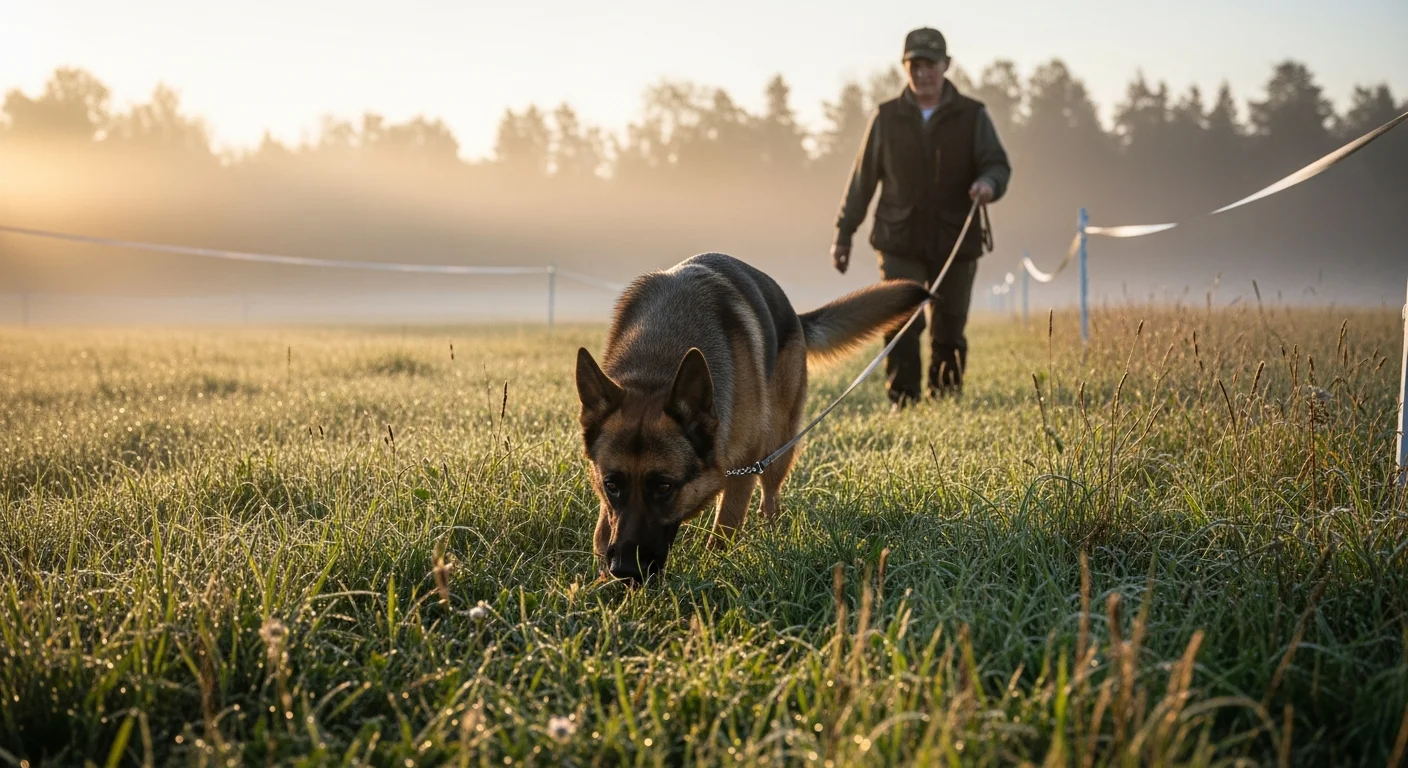
Why Tracking Matters in Breed Standards
Tracking is not simply a party trick or an arbitrary requirement. The ability to follow a scent trail with focus and persistence reflects a specific neurological and motivational profile that correlates with other traits relevant to working dogs. A dog with sufficient hunt drive and olfactory acuity to follow a cold track across a large field, through distracting odors, for an extended period without losing concentration, is a dog with the motivational profile necessary for real working tasks.
The tracking component of IGP evaluations requires a dog to follow a human footprint track laid by the handler, find articles placed on the track, and indicate each article by lying down with the article between its front paws. As tracking levels advance — from IGP1 to IGP3 — the tracks become longer, older, more complex in their path geometry, and laid by strangers rather than the handler. IGP3 tracking requires following a track laid by a stranger, crossing older tracks, with multiple directional changes, under real field conditions.
A dog that can pass IGP3 tracking has demonstrated nose work capability that would transfer directly to search-and-rescue operations, cadaver detection work, or any field application requiring sustained scent discrimination. The test is not designed to select search-and-rescue dogs specifically; it is designed to evaluate whether a dog possesses the drive, focus, and olfactory capability that the breed was historically used for. That this capability is also useful in modern working roles is not coincidental.
What Tracking Actually Evaluates
The specific behavioral components evaluated in a tracking trial include: nose engagement intensity (how actively the dog uses its nose versus using its eyes or guessing the path), line control (how precisely the dog follows the actual track versus cutting corners or anticipating direction changes), article indication (the clarity and reliability of the dog's behavior when it finds an article on the track), and persistence (whether the dog maintains engagement across the full duration of a long, old, or complex track).
Dogs that track visually — following crushed vegetation or handler footsteps visible to the eye rather than following the scent trail — may pass simple tracking tests but fail as tracking conditions become more demanding. The evaluation design, particularly at IGP2 and IGP3 levels, is specifically constructed to make visual tracking unreliable, forcing genuine scent use. A handler can identify a visually tracking dog; the track design tests confirm it.
The genetic basis of tracking ability is both cognitive and olfactory. The capacity to discriminate between the specific combination of scent molecules that constitute a particular person's ground track from background environmental odors involves olfactory receptor density and specificity that is at least partly heritable. The motivational component — the drive to pursue and complete the track — is also heritable, varying substantially between lines with different selection histories. Tracking performance thus reflects genuine genetic information about the dog's capabilities.
FCI Obedience Titles: The International Obedience Programme
The FCI International Obedience Programme offers working titles (FCI Obedience1 through FCI Obedience3) that are separate from the IGP system's obedience phase and more precisely calibrated to measure obedience precision in controlled conditions. FCI obedience trials require heel work on and off leash, recall, stays under distraction, directed retrieve, directed jumping, and scent discrimination exercises at advanced levels.
The obedience phase of IGP is less refined than dedicated obedience competition but fulfills a different function: it tests whether a dog can perform reliably under pressure in an environment that also involves significant protection work stimulation. An IGP obedience evaluation takes place in the presence of a decoy, with protection-related stimuli in the environment. The dog must perform precise heelwork, recall, retrieve, and send-away exercises while aroused by the environmental context of a protection sport scenario.
This stress-loading is deliberate and important. Obedience that functions only in quiet training environments is insufficient for working dogs that must be controlled in operationally stressful situations. The IGP obedience phase specifically tests whether a dog can maintain trainability and handler responsiveness under the kind of arousal that operational work creates. A dog that heels perfectly in a quiet field but degrades in obedience quality as protection stimuli increase has revealed a functional limitation that the IGP format is designed to expose.
Scent Work: Detection Titles and Tracking Compared
FCI tracking evaluations within IGP are one approach to scent work assessment. Several national and international organizations maintain distinct scent work and detection titles that evaluate nose work in different contexts. The FCI's International Search and Rescue Dog Organisation (IRO) maintains evaluations for search-and-rescue dogs that go significantly beyond IGP tracking in their demands: area search under challenging conditions, rubble search, avalanche search, and water work components.
The IRO evaluations represent the working end of the scent work spectrum — dogs evaluated under conditions approximating real emergency response work. Unlike IGP tracking, which tests a specific stylized behavior pattern, IRO evaluations test whether a dog can independently problem-solve a search scenario, work with sustained drive in physically demanding conditions, and clearly indicate to a handler when a live human has been located.
For breed standard purposes, the relevant question about scent work evaluations is not which specific protocol is used but whether the evaluation tests genuine scent-working capability that reflects the dog's genetic potential. The specific format matters less than the discriminating validity of the evaluation — whether it actually distinguishes dogs with working scent capability from dogs without it. Both IGP tracking and IRO evaluations satisfy this criterion when properly administered.
"Tracking reveals things about a dog that you cannot see in any other setting. How much it wants something. How much it will commit when the problem is difficult. Whether it trusts its nose or looks for help. These are not training products. They are genetic products that training develops. The tracking evaluation reads the genetics."
The BH: Foundation Evaluation for Working Dogs
Before a dog can enter IGP competition, it must earn the BH (Begleithund or companion dog title). The BH is a foundational evaluation that assesses basic social behavior and obedience: heel work on and off leash, sit, down, stay, and recall. Critically, the BH also includes a traffic section: the dog is evaluated in a real-world environment with pedestrians, cyclists, passing vehicles, crowds, and other dogs. Dogs that show uncontrolled anxiety, aggression, or inability to function in a public environment fail.
The BH does not test working drives or advanced capabilities. What it tests is the baseline social and behavioral stability that working dogs must have before they can enter more demanding evaluations. A dog that cannot pass the BH traffic section does not belong in a working breeding program, not because it might fail IGP but because it lacks the environmental stability that working dog breeds are supposed to carry in their genetics.
For breed standard enforcement purposes, the BH represents a minimum functional threshold. Clubs that require only a BH as a working evaluation are setting a low standard — the BH confirms that a dog is not pathologically reactive in public, not that it is a functional working animal. This is meaningfully better than no evaluation, but substantially less demanding than what the IGP framework requires. Understanding this hierarchy is important when evaluating claims that a breed club "requires working evaluations" without specifying what those evaluations entail.
Breed-Specific Working Evaluations
Beyond the universal FCI framework, many breed clubs maintain evaluations specific to their breeds' original functions. Herding breed clubs conduct herding instinct tests and herding trials. Hunting breed clubs conduct field trials appropriate to the breeds' hunting functions. Protection breed clubs conduct IPO-style evaluations. Retriever clubs conduct hunting tests and field trials. Each of these breed-specific evaluations tests whether the dog possesses the genetic behavioral package that its breed was created to deliver.
The specific evaluation required by a breed club reflects that club's judgment about which behaviors define the breed's essence. For a working herding breed, herding instinct tests are as meaningful as IGP tracking is for a protection breed. The common principle across all these evaluations is that they provide functional verification of traits the written standard can only describe — a measurement that words cannot substitute for and that judges at conformation shows cannot provide regardless of how closely they read the written standard.
The relationship between breed-specific evaluations and breed standard enforcement is directly tied to the debate about how working title requirements declined across major kennel clubs. Each specific evaluation that was replaced with a less demanding alternative, or made voluntary, or eliminated entirely, represented a decision to accept description as a substitute for verification. Those decisions are the mechanism through which working capacity has been lost in one breed population after another.
What the Titles Mean for Breeding Decisions
For breeders and buyers making decisions about working dog breeding, understanding what specific titles actually verify is essential to evaluating the quality of breeding stock documentation. A dog with an IGP3 title has been evaluated for tracking, obedience, and protection work across three increasing difficulty levels. A dog with a BH has been evaluated for basic social stability. A dog with only a show title has been evaluated for conformance to the written standard in the opinion of a licensed conformation judge — which is real information, but not information about functional working capacity.
Pairing working title documentation with health testing documentation and conformation evaluation results provides the most complete picture of a potential breeding animal's quality. The three components address different dimensions of breed quality that no single evaluation can cover. This is why the most rigorous breed club systems, like those described in the analysis of ADRK requirements for Rottweilers, require all three before approving a dog for breeding.
The title is not the dog. An individual title tells you about that individual dog on that evaluation day under those specific conditions. A breeding program's track record in producing titled dogs across many litters and generations tells you something more important: whether the breeding system reliably produces dogs capable of meeting the standard. That is the information that matters for breed preservation, and it is information that only accumulates when working evaluations are consistently conducted and consistently recorded.