
Swiss Cattle Dog Working Standards: Appenzeller, Entlebucher, and the Drover's Legacy
Switzerland's four Sennenhund breeds — the Bernese Mountain Dog, the Greater Swiss Mountain Dog, the Appenzeller Sennenhund, and the Entlebucher Mountain Dog — share a common origin in the Alpine droving and farming culture of the Swiss cantons. They share a tricolor coat pattern, a molosser heritage, and a functional history as all-purpose farm and livestock dogs. Beyond these commonalities, their modern trajectories have diverged substantially, offering a comparative study in what happens when different breeds within the same functional family experience different degrees of show breeding pressure.
The Bernese Mountain Dog, the most internationally popular of the four, presents the most cautionary case: a breed that was once a robust working farm dog is now disproportionately represented in veterinary oncology literature, with median lifespans significantly shorter than other breeds of comparable size and a working temperament substantially softer than historical accounts of the breed describe. The Appenzeller and Entlebucher, less popular internationally and more tightly held by Swiss breed clubs with working orientations, have maintained more of their original functional profile. Understanding why requires understanding what their different club structures have preserved or failed to protect.
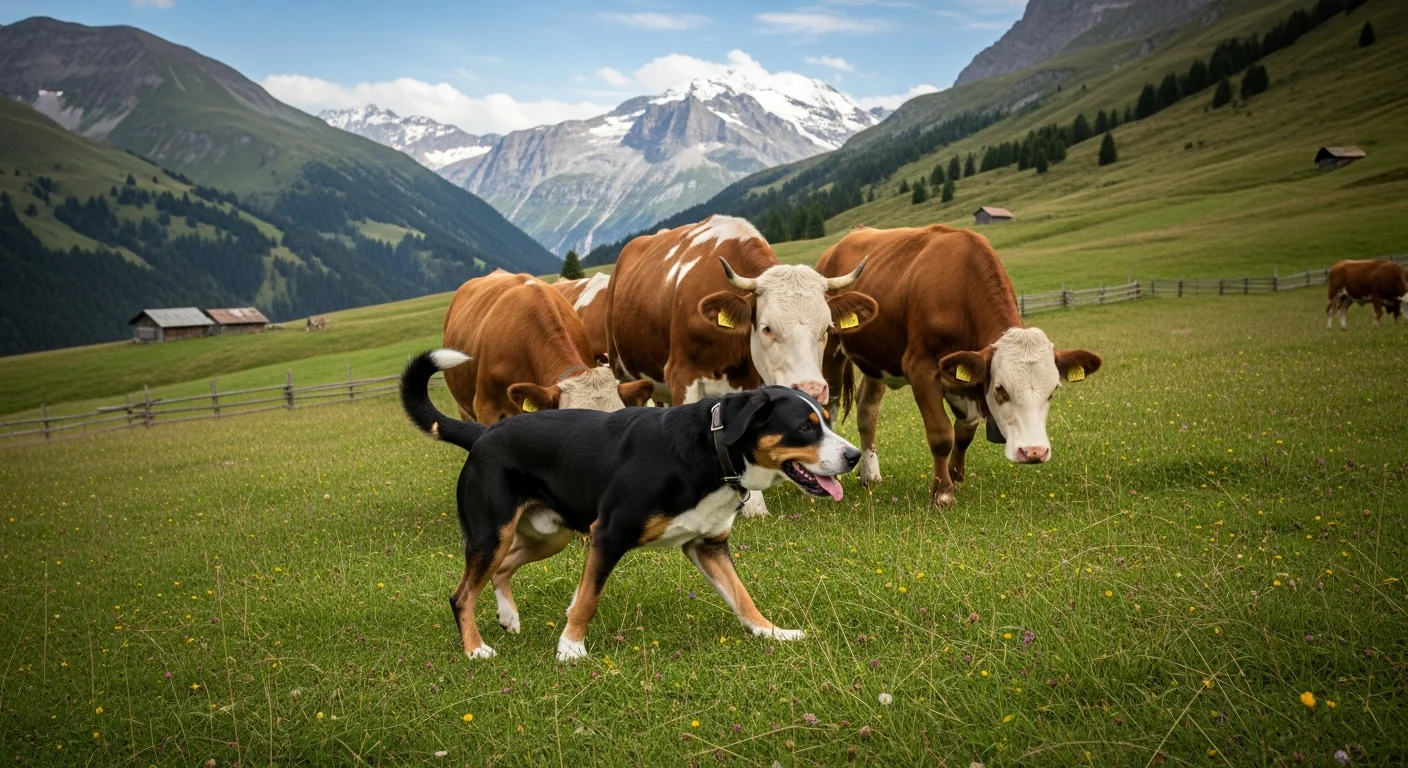
The Appenzeller Sennenhund: Working Club Structure
The Appenzeller Sennenhund Club (ASK) in Switzerland has maintained a working orientation in its breeding requirements more consistently than the clubs managing the more popular Sennenhund breeds. The ASK requires that dogs used for breeding pass a character evaluation that assesses working temperament, environmental stability, and social behavior. The evaluation is not equivalent to an IGP title in its demands, but it provides meaningful discrimination between dogs with functional temperament and those with insufficient stability for the breed's historical work.
The Appenzeller is classified by the FCI as a herding and cattle dog, and Swiss breed clubs have maintained connections to this herding function through working test requirements that go beyond the typical temperament test in many European club systems. Dogs must demonstrate the behavioral characteristics — the gathering instinct, the voice work, the physical confidence around livestock — that the breed was created to perform. This is not nostalgia. It is the maintenance of a genetic behavioral package that exists in the Appenzeller and that cannot be restored once lost.
The Appenzeller's relative rarity outside Switzerland has contributed to the preservation of its working characteristics, for the same reasons that the Dutch Shepherd's obscurity protected it from the worst consequences of popularity-driven show breeding. When a breed is not widely popular in non-working markets, the breeders who maintain it tend to be those with functional rather than aesthetic motivations. The selection pressure they apply, even when informal, skews toward the behavioral traits that motivated their interest.
The Entlebucher: Compact Function
The Entlebucher Mountain Dog is the smallest of the four Sennenhund breeds and was used primarily as a cattle dog in the Entlebuch valley of central Switzerland. Its compact size made it more agile than its larger relatives for the specific work of moving cattle in confined alpine environments — narrow paths, rocky terrain, farm buildings — where a larger dog's size would have been a disadvantage.
The ESKS (Entlebucher Sennenhund Club Schweiz) maintains breeding standards that reflect the breed's working heritage. Health testing requirements are comprehensive, particularly for ectopia lentis, a heritable eye condition specific to the Entlebucher that can cause lens dislocation and blindness. The integration of health testing into breeding requirements in a breed with a specific, heritable condition demonstrates the practical value of mandatory health evaluation: when a serious genetic defect is known to be prevalent in a population, mandatory testing is the only reliable mechanism for reducing its frequency across the breeding population.
Working character evaluation is also part of Entlebucher breeding requirements in Switzerland, though the specific standards have evolved over time. The breed's working history as a cattle dog is reflected in character requirements that assess drive, confidence, and the behavioral traits associated with livestock management work. Dogs that lack these traits do not meet breeding standards, regardless of their conformation excellence.
The Bernese Mountain Dog: A Cautionary Contrast
The Bernese Mountain Dog's trajectory illustrates what popularity without adequate working standards can do to a breed over a relatively short period. The Berner entered the international show circuit in the early twentieth century and became popular enough in show communities to attract breeding investment from show breeders who were not connected to Swiss farming communities or to the working function that had produced the breed.
The health consequences are documented and severe. Histiocytic sarcoma, a cancer that is rare in most breeds, accounts for a substantial proportion of Bernese deaths. Median lifespan figures that were once compatible with large breed dogs declined dramatically across the twentieth century as the gene pool that entered the show breeding community was expanded with animals that carried genetic disease loads that functional selection would have reduced. When you breed for appearance without evaluating health or working function, you lose both health and function simultaneously.
The Bernese example is directly relevant to genetic diversity in closed registries because it shows what happens when a closed registry population is founded from a narrow base and then expanded rapidly under show breeding selection without the counter-pressure of functional evaluation. The health crisis is the health consequence of a breeding crisis that began when working function was no longer selected for.
Swiss Club Structures and the FCI Framework
The Schweizer Kynologische Gesellschaft (SKG) is Switzerland's FCI member club and oversees breed clubs for the Sennenhund breeds. The relationship between the SKG's overall framework and the specific requirements maintained by individual breed clubs reflects the general FCI architecture: national clubs set standards within FCI guidelines, but breed clubs often maintain additional requirements specific to their breeds.
For the Sennenhund breeds, the most stringent requirements are maintained by the breed clubs most directly connected to Swiss working farming culture — the ASK and ESKS — rather than by the national club or the more internationally distributed Bernese Mountain Dog clubs. This pattern is consistent with the general principle that working requirements are most reliably maintained by communities with direct connections to the working function, not by clubs whose membership is predominantly interested in conformation competition.
The European breed warden systems that operate within Swiss clubs follow the same Zuchtwart model used in German breed clubs: licensed breed wardens inspect litters, evaluate kennels, and provide continuity of mentorship that formal requirements alone cannot supply. The Swiss system has generally maintained this infrastructure more effectively for the smaller, rarer breeds — the Appenzeller and Entlebucher — than for the more popular Bernese, where the scale of breeding has outpaced the capacity of traditional breed warden systems to provide meaningful oversight.
"The Appenzeller is not famous. That has saved it. The people who breed Appenzellers in Switzerland mostly grew up with them, understand what they were for, and know what they should be. When a breed becomes internationally fashionable, those people are replaced by enthusiasts who love the look but have never seen one work cattle."
Working Tests for Droving Breeds
The working tests relevant to droving breeds differ from the IGP framework used for protection breeds and the herding tests used for sheepdog breeds. Droving dogs work with cattle rather than sheep, in environments that differ from both sheepdog trials and IGP training fields. Cattle dog tests evaluate the dog's willingness to use its voice, its capacity to use body pressure to redirect cattle movement, its ability to work independently of close handler direction, and its physical confidence around large livestock.
Swiss breed clubs have maintained droving-specific working evaluations for the Sennenhund breeds, though the frequency and accessibility of these evaluations has declined as working farms with suitable cattle have become less common. The same infrastructure collapse that has affected working title training in protection breeds — fewer working environments, fewer experienced trainers, smaller communities of practitioners — has affected droving breed evaluations. Maintaining functional working tests requires maintaining the agricultural connections that give those tests practical context.
This infrastructure challenge is not unique to Switzerland. It reflects a broader tension in all working breed systems: as the original working context becomes less common, the infrastructure for evaluating working capacity deteriorates, making working evaluations less accessible, which reduces participation, which further erodes the infrastructure. Breaking this cycle requires deliberate institutional investment in maintaining evaluation infrastructure even as the original working context becomes less economically central to the community.
Lessons from the Swiss Model
The Swiss Sennenhund breeds collectively offer a natural experiment similar to what working and show line comparisons provide in other breed families. Four breeds of common origin, different popularity levels, different degrees of show breeding pressure, and notably different preservation of working characteristics and health. The correlation between working-oriented breed club requirements, relative obscurity from show breeding pressure, and preservation of functional characteristics is consistent with the pattern observed in other working breed families.
The practical lesson is that working requirements embedded in breed club standards, maintained by communities with functional motivations, and supported by infrastructure capable of conducting meaningful evaluations are the most reliable mechanism for preserving what working breeds were created to be. The Swiss example adds the health dimension: where working evaluation requirements coexist with comprehensive health testing requirements, both working capacity and breed health are better maintained than in populations where either or both are absent.
Understanding this pattern helps contextualize the debate over reforming kennel club standards to include functional evaluation. The argument that show breeding and working breeding should be unified under requirements that evaluate both is supported by the evidence from Swiss cattle dog breeds, where the more successfully preserved breeds are those maintained by communities that never fully separated the two.