
Protection Sport Breeding: French Ring, Mondio Ring, and Working Selection
The working dog sport landscape is more varied than discussions of IGP (formerly Schutzhund/IPO) typically acknowledge. While IGP receives the most attention in English-language breed standard discussions — partly because it is the evaluation most integrated into German breed club requirements, and partly because German breed clubs have the highest international profile — several other protection sport systems function as working dog evaluation and breeding selection tools with distinct emphases and demanding standards.
French Ring and Mondio Ring are the most prominent of these alternatives, and they occupy a position in working dog breeding that is in some respects more demanding than IGP. Understanding their evaluation frameworks, the breeds they have shaped, and the selection pressures they apply illuminates both the range of working dog evaluation approaches and the different kinds of working capacity they preserve.
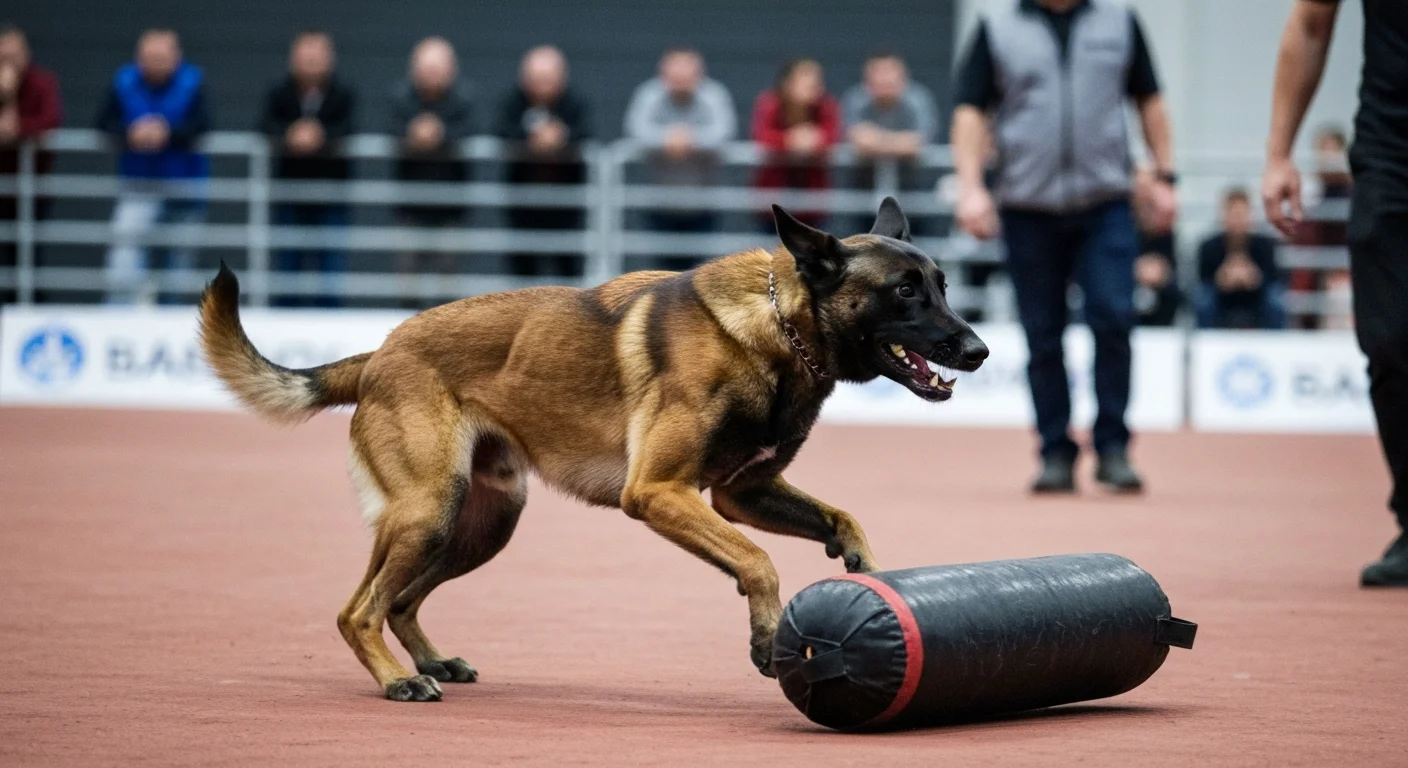
French Ring: The Original High-Performance Standard
French Ring (Ring Français) is the oldest and most prestigious of the ring sport disciplines, developed in France in the early twentieth century as an evaluation of the complete working dog. Unlike IGP, which separates tracking, obedience, and protection into distinct phases scored independently, French Ring integrates obedience and protection elements in a way that more closely resembles real operational scenarios. The dog must perform obedience exercises immediately before, during, and after protection scenarios, demonstrating that its training functions across the full range of arousal states the sport produces.
French Ring requires no formal tracking component — a significant difference from IGP that reflects the French working dog tradition's different priorities. In place of tracking, Ring places more emphasis on obedience precision and jump work (the dog must clear obstacles including both a horizontal jump and a palisade wall) that test physical ability alongside working drive. The protection work in Ring is civil in nature — the decoy wears real street clothing rather than a full bite suit in some exercises — which tests the dog's generalization of protection behavior to scenarios that more closely resemble actual confrontation situations.
The competitive structure of French Ring moves through three levels (Ring 1, Ring 2, Ring 3) with increasing demands at each level. Ring 3 is considered among the most demanding individual working dog sport evaluations in the world. Dogs that compete successfully at Ring 3 must be genuinely exceptional working animals — physically capable, behaviorally precise under extreme arousal, and handled with the skill that Ring 3 level performance requires.
What Ring Sports Select For
The selection pressure applied by Ring sport competition is different in specific ways from the selection pressure applied by IGP. Ring's protection work emphasizes what working dog evaluators call "civil" engagement — the dog's willingness to engage a threatening person in the absence of the prey-trigger equipment (sleeve or suit) that makes protection work simpler in prey-drive-dominant dogs. A dog that bites a sleeve because it is attracted to the sleeve as a prey object is demonstrating a different behavioral basis than a dog that engages a decoy in street clothing because it perceives that person as a genuine threat to the dog or its handler.
Ring sports select more specifically for the latter: genuine social aggression in defense of the handler, combined with the training compliance that ensures this behavior is fully under command. This is behaviorally demanding in a way that emphasizes the defense drive component of working behavior more than IGP, which can be successfully completed by dogs with predominantly prey-drive-based engagement profiles.
The breeds that have historically dominated Ring sport competition reflect these selection pressures. Belgian Malinois have dominated French Ring for decades, a dominance that predates their current prominence in military and police work and partly explains that prominence. The Malinois's combination of drive intensity, trainability, and physical capability suits Ring requirements in ways that larger, heavier breeds cannot match at the highest competitive levels. Belgian Tervurens have also produced competitive Ring dogs. German Shepherds appear in Ring competition, but the physical requirements of Ring — particularly the jump work — favor the lighter, more agile Belgian breeds.
Mondio Ring: The International Version
Mondio Ring (Mondioring) was developed in the 1980s as an international version of the Ring concept, adapted to be accessible to countries outside France's established Ring sport infrastructure while maintaining the essential evaluation philosophy. The International Mondio Ring Association (IMBA) promotes the sport internationally and sanctions events in Europe, North America, and other regions.
Mondio Ring differs from French Ring in several structural ways while maintaining the integration of obedience and protection work and the emphasis on civil protection scenarios. Mondio Ring includes a bite bar exercise that is specific to its format and not found in French Ring. The judging system and scoring structure differ. The competitive community, while overlapping with French Ring, is distinct.
For working dog breeding purposes, Mondio Ring titles function similarly to French Ring titles: they verify high-level working capacity in dogs that have demonstrated physical ability, drive intensity, handler focus, and the specialized training that high-level Ring sport requires. The breeding communities that participate in Ring sports select their breeding stock based on competitive performance, creating the same market pressure that aligns breeding selection with functional performance in the IGP community.
Ring Sport Breeding Communities and Standards
The French Ring sport community in Belgium and France has historically been one of the most active working dog breeding communities in the world, producing the Belgian Malinois and Belgian Tervuren lines that now supply military and police programs globally. This community did not explicitly set out to create elite military working dogs. It set out to breed competitive Ring dogs. The dogs that resulted from selection for Ring competition proved suitable for military and police work because competitive Ring performance requires the same fundamental traits — drive, nerve, trainability, physical capability — that operational working roles demand.
This accidental convergence between sport selection and operational requirements is not accidental at a deeper level. Both Ring sport and operational working dog use select for the same underlying functional traits. The sport provides a standardized, competitive evaluation of those traits that operates as an effective breeding selection tool. As with IGP, the sport's competitive structure creates incentives for breeders to produce genuinely capable dogs rather than dogs that can pass a minimum evaluation standard.
"Ring selects for a complete dog. The obedience must function when the dog is at maximum arousal, after protection work, under the pressure of competition and crowd noise. The protection work must function off equipment, in street clothing, with realistic scenario pressure. You cannot fake Ring at the high levels. The dog either has it or it doesn't."
Ring Sports and Breed Club Requirements
Ring sport titles are not currently integrated into formal breeding requirements for any of the major working breeds in the way that IGP titles are integrated into German breed club systems. This reflects the geographical distribution of the sports: French Ring is primarily a Belgian and French phenomenon, while German breed club systems that maintain formal breeding requirements are designed around German sport infrastructure including IGP.
However, Ring sport titles are recognized as equivalent working evaluations in some FCI member countries for breeds where working titles are required for breeding. A Belgian Malinois in Belgium with a French Ring 1 title may satisfy working evaluation requirements that specify "working title" without specifying which working title system. The specific recognition varies by country and club, but the principle — that Ring sport titles verify working capacity equivalently to other recognized evaluation systems — is accepted in working communities even when not formally codified.
The question of how Ring sport titles should be integrated into breed standard enforcement is relevant to the broader discussion of what FCI breeding requirements should include. A system that requires a working title without specifying which working title is more flexible but potentially allows easier titles to substitute for more demanding ones. A system that specifies IGP may artificially disadvantage dogs from Ring sport communities. Getting the specification right requires understanding what each system actually tests and what the breed standard actually requires.
Belgian Malinois: The Ring Sport Breed
The Belgian Malinois's dominance of high-level Ring competition and its current prominence in military and police programs are directly connected. The same breeding community that produced Ring competitors produced the supply chain for serious working programs. Understanding the Ring sport selection framework helps explain why Malinois from Belgian working lines perform at levels that few other breeds can match: they have been selected under competitive conditions that reward exactly the traits that operational work requires.
The risk to this system is the one affecting all working breeds that attract external attention: show breeding interest that is not connected to Ring competition or operational working requirements. As Malinois popularity has expanded beyond the working community — partly as a result of visible military and police deployments, partly as a general trend toward athletic working breeds — non-working breeders have entered the market without the selection pressure that the Ring sport community applies. The parallel trajectory of the Dutch Shepherd illustrates the risk: popularity without integrated working requirements is the mechanism through which working capacity erodes in otherwise excellent breeds.
Other Protection Sports and Breeding Selection
Beyond IGP, French Ring, and Mondio Ring, several other protection sport systems function as working dog evaluation tools in their regional communities. Belgian Ring, the predecessor to the French Ring sport, remains active in Belgium with its own specific exercises and competitive structure. The KNPV in the Netherlands, while technically an organization for police dog sport rather than a competition sport in the entertainment sense, functions as a breeding selection environment that produces some of the most operationally capable working dogs in the world.
North American protection sports including AKC Scent Work, NAPD protection sport, and various regional organizations provide accessible working evaluation options in a market where formal protection sport participation has historically been limited. These organizations vary considerably in the demands of their evaluations and the extent to which their competitive structure creates meaningful selection pressure for working capacity. The same principle that distinguishes effective working evaluations from inadequate ones applies: meaningful evaluation must discriminate between working-capable and working-incapable animals, with pass rates that reflect genuine discrimination rather than nearly universal passage.
For anyone seeking to understand working dog breed standards in their full context, the Ring sport world is an essential part of the picture. It represents a tradition of working dog evaluation that is distinct from, and in some respects more demanding than, the IGP framework that receives the most attention in English-language discussions. The dogs it produces, and the breeding communities that maintain it, are among the most important resources for working breed preservation — and among the most threatened by the same popularity pressures that affect working capacity throughout the working breed world.