
Newfoundland Water Rescue Breed Standard: Function vs Show Ring Drift
The Newfoundland is perhaps the least discussed of the working breeds experiencing the show ring versus function divide, partly because its original work — water rescue and fishing assistance — is not represented by an active competitive sport infrastructure comparable to IGP or French Ring. There is no world championship for Newfoundland water rescue. There is no title system equivalent to an IGP that would allow breed clubs to require demonstrated water rescue ability as a breeding prerequisite. And yet the breed's physical structure, behavioral profile, and genetic endowment were shaped entirely by the demands of cold water work in the North Atlantic fishing communities of its origin.
Understanding what the Newfoundland was built for — and how those requirements translate into specific structural and behavioral characteristics — is essential for evaluating whether current show ring selection is maintaining or eroding what the breed is supposed to be. The answer, in most international show communities, is eroding. The exception is the Italian water rescue tradition, which has maintained a direct connection between the Newfoundland's original function and its breeding selection that the show world has largely abandoned.
What Water Rescue Requires Structurally
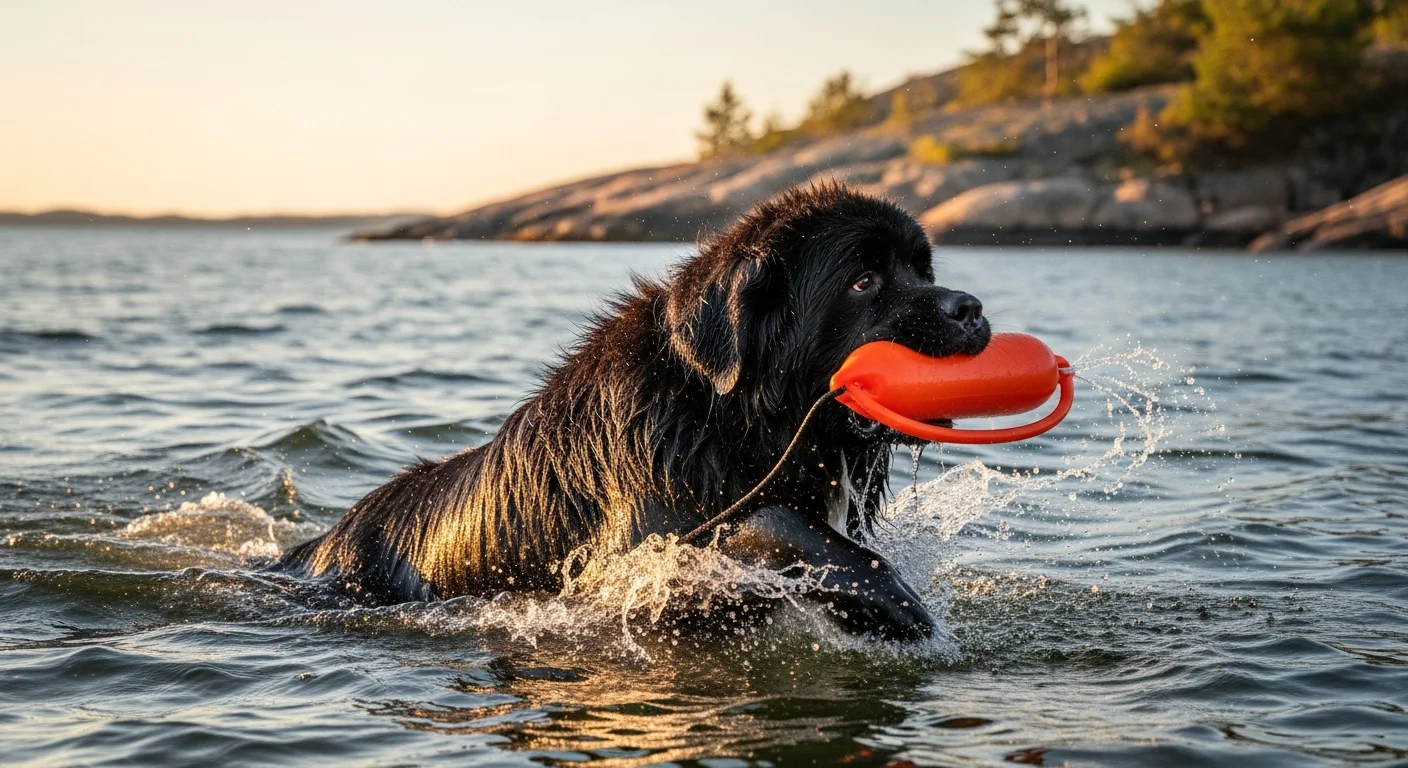
A dog that rescues drowning persons or assists fishing crews in cold North Atlantic water requires a specific structural package. The Newfoundland's large, powerful body is not incidental to the breed. It is the physical consequence of what the work demands: a dog must be large enough to pull a drowning adult to safety, have the muscular development to sustain powerful swimming in cold water with significant resistance load, have the lung capacity for extended aquatic exertion, and have the insulating coat and body composition to maintain thermal regulation in water temperatures that would incapacitate most breeds rapidly.
The Newfoundland's characteristic flat, water-resistant double coat is a functional adaptation, not an aesthetic choice. The outer coat repels water when the dog enters; the dense undercoat maintains thermal insulation even when wet. A Newfoundland whose coat has been selected for dramatic length and volume over water resistance is a Newfoundland whose coat has been optimized for the show ring rather than for the water. These are different selection criteria that produce different coats.
The breed's famous webbed feet are another structural feature directly tied to swimming efficiency. Webbing between the toes increases propulsive surface area, improving forward movement efficiency in water. Show ring judges typically evaluate foot structure in terms of tightness and roundness rather than webbing function — the aesthetic standard for feet does not necessarily preserve the functional standard. Dogs selected primarily for foot aesthetics rather than foot function may retain webbing that appears correct visually while losing the specific web depth and flexibility that maximizes swimming propulsion.
Behavioral Requirements: What the Water Reveals
Beyond structure, water rescue work requires a specific behavioral profile that is as genetically based as the physical traits. A Newfoundland that refuses to enter cold, rough water is not a water rescue dog regardless of its structural correctness. The breed should show a natural affinity for water — entering willingly, swimming powerfully, and exhibiting the instinctive orientation toward a swimmer in distress that experienced observers describe as "rescue behavior." A dog that swims for its own enjoyment is not demonstrating the same behavioral profile as a dog that swims toward a struggling person and orients its body to provide a tow line.
These behavioral traits are heritable, and they vary between lines. Working rescue lines bred with water work as a primary selection criterion show higher frequencies of natural rescue orientation behavior than lines bred primarily for show success. The mechanism is the same one that operates in all working breed populations: selection for function maintains function, selection for appearance allows function to erode.
The temperament profile associated with effective water rescue work — calm confidence in chaotic water conditions, the social orientation toward people in distress that motivates rescue behavior, the trainability that allows coordination with handlers during multi-dog rescue operations — is not the same temperament profile that wins in the show ring. Show ring success rewards a dog that is calm, manageable, and impressive in controlled environments. Water rescue success requires a dog that activates behaviorally in chaotic, stressful environments. These are different behavioral phenotypes.
The Italian Water Rescue Tradition
Italy has developed the most active and internationally respected system for evaluating Newfoundland water rescue ability, centered on the Scuola Italiana Cani Salvataggio (SICS) — the Italian School of Water Rescue Dogs. Founded by Ferruccio Pilenga in 1989, SICS has developed a comprehensive training and evaluation system for water rescue dogs, with the Newfoundland as one of the primary breeds. The system includes certification levels for water rescue performance and has been adopted by coast guard units and beach patrol services in Italy and internationally.
SICS evaluations include increasingly demanding water rescue scenarios: swimming to a distressed swimmer and allowing the person to hold the dog's tail for towing, retrieving a line to a swimmer, towing a lifeboat, and multiple-dog coordination exercises. The evaluations are conducted in open water, not controlled pool environments, introducing the real-world variables — currents, waves, variable visibility — that actual rescue work involves. Dogs that perform at SICS certification levels are genuinely functional water rescue animals, demonstrating the behavioral and physical traits the Newfoundland breed was created to possess.
Italian Newfoundland breeders connected to the SICS working tradition evaluate breeding candidates partly based on water rescue performance. This is not a universal requirement in Italian Newfoundland breeding, but the working community's influence creates market demand for dogs with demonstrated rescue capability that does not exist in countries where the SICS tradition is absent. The result is a subset of the Newfoundland breeding population in Italy that maintains working water rescue characteristics more effectively than most international show-oriented populations.
Show Ring Drift in the Newfoundland
International show Newfoundlands have drifted from working water rescue requirements in specific structural ways. Size has increased beyond what swimming efficiency would favor — larger, heavier dogs require more effort to propel through water and carry more thermal mass that increases the risk of hypothermia in cold water despite their insulating coats. Coat volume has been selected for dramatic visual impact over water-repelling function. Movement has been selected for a slow, rolling, impressive gait rather than the efficient, ground-covering movement that physical labor over rough terrain and in water demands.
The health implications of these show ring trends are directly connected to the structural drift. Excessive size increases orthopedic stress, reducing working longevity. The Newfoundland is already a breed at elevated risk for heart disease (subvalvular aortic stenosis and dilated cardiomyopathy are both documented in the breed), and selection that emphasizes size over soundness can interact with genetic predispositions for cardiac disease. The health testing requirements across international registries for the Newfoundland reflect awareness of these risks, but testing without structural selection toward working function addresses symptoms rather than causes.
"I have put both show Newfoundlands and working Newfoundlands in the water. The working dogs swim better, last longer, and show what you want in a rescue dog — they go toward the person, not away. Many of the show dogs swim adequately. A few are surprisingly hesitant. None of them work the way the breed was supposed to work. That is not a criticism of the dogs. It is a criticism of what they were selected for."
Water Rescue Titles as Breed Standard Enforcement
The SICS certification system functions as a breed-appropriate working evaluation in the same way that IGP functions for protection breeds: it tests whether the dog possesses the behavioral and physical traits the breed standard describes in words. The difference is that SICS certifications are not integrated into formal breeding requirements in any national kennel club system the way IGP titles are integrated into German breed club requirements.
Integrating water rescue performance requirements into Newfoundland breeding standards would face the same political obstacles that working title requirements face in any breed where show breeding has become dominant. The show breeding community would resist requirements that their dogs cannot meet. The working rescue community is smaller and has less political weight within national kennel clubs. This is the same dynamic that has driven the decline of working titles in other breeds, operating in a breed where the working tradition has never been formally integrated into registry requirements in the first place.
What the Newfoundland Teaches About Diverse Working Functions
The Newfoundland case illustrates that the working breed standard problem is not limited to protection and herding breeds with active sport evaluation systems. Every working breed has an original function, every original function placed specific demands on structure and behavior, and every one of those demands is encoded in what the breed standard describes. When selection for show ring success diverges from selection for original function, the same erosion of working capacity occurs regardless of whether the breed's work is protection, herding, or water rescue.
The tool for preventing this erosion is always the same: some form of functional evaluation connected to breeding decisions. For protection breeds, this means IGP or Ring sport titles. For herding breeds, it means herding evaluations. For water rescue breeds, it means evaluations like the SICS system. The specific evaluation must be designed around the specific work. The principle — verify function, not just appearance — applies universally across working breed types.
For anyone concerned with breed preservation through working programs, the Newfoundland offers both a warning and a model. The warning is that without formal working requirement integration, show breeding pressure will erode working characteristics in any breed popular enough to attract non-working breeders. The model is the Italian water rescue tradition, which demonstrates that maintaining direct connection between breeding decisions and functional evaluation preserves what the written standard alone cannot.