
Livestock Guardian Dog Breed Standards: Function Without Training
Livestock guardian dogs represent a category of working breed whose function is fundamentally different from herding breeds, protection sport breeds, or any working breed that relies primarily on handler direction. A livestock guardian dog works alone, at night, in weather that discourages human presence, against threats that require a response calibrated to context — discouraging, chasing, or physically confronting predators as the situation demands. The training that develops a German Shepherd's protection work or a Border Collie's herding is not what produces a Kangal's flock protection behavior. The behavior is genetic. The shepherd's role is management, not instruction.
This fundamental difference in the nature of their work creates distinctive requirements for livestock guardian breed standards. The relevant traits cannot be verified with titles awarded for performing exercises on command. They can be verified only by observing whether the dog does, spontaneously, what the genetics of a working livestock guardian should produce: bonding with livestock, remaining with the flock, and responding to threats with appropriate deterrence or confrontation. These are complex behavioral patterns encoded in the genetics of working livestock guardian populations, and they erode when those populations are separated from their working function.
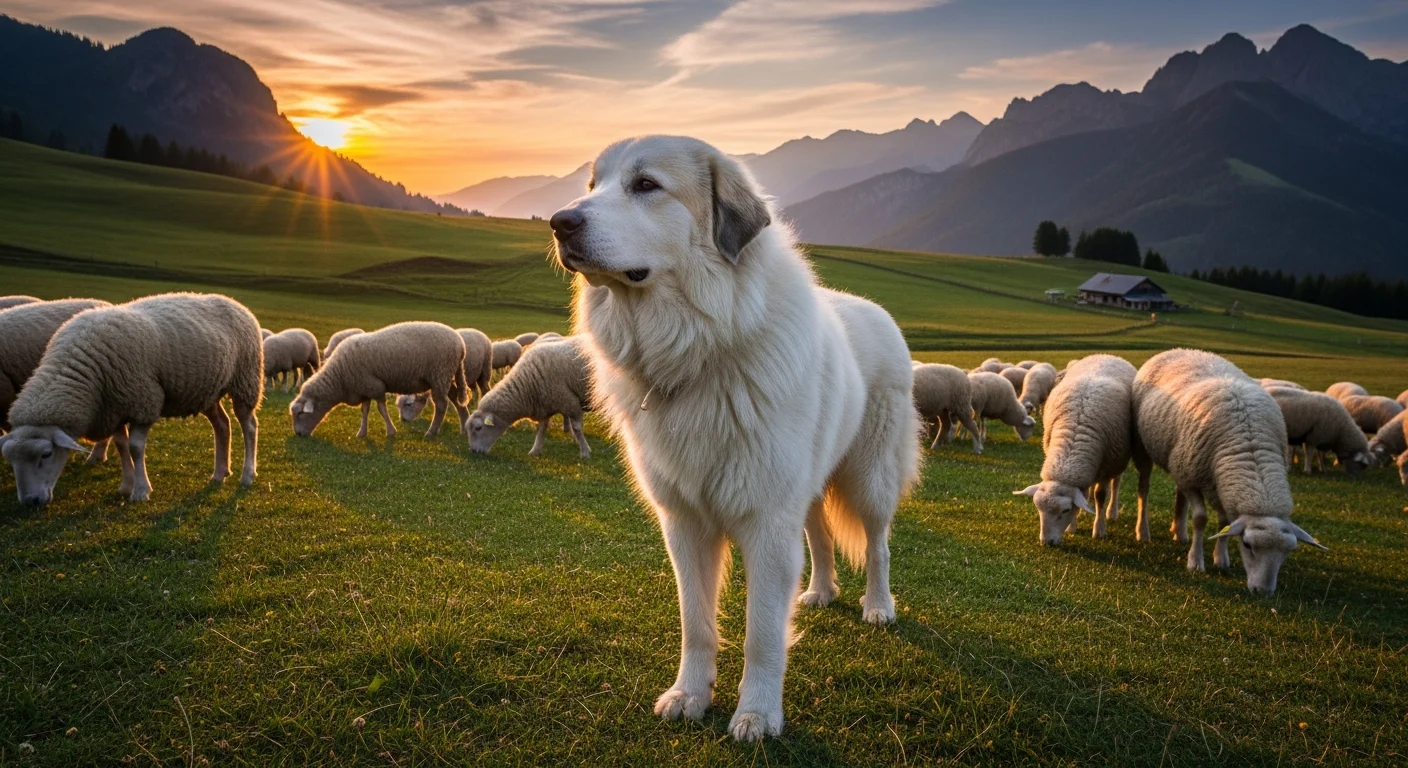
The Behavioral Genetics of Flock Bonding
The central behavioral trait that distinguishes livestock guardian dogs from other dog types is flock bonding: the tendency to identify with and remain with livestock rather than with humans or the dog's own species. This behavior is not trained. Puppies raised with livestock develop the bonding attachment that enables their guardian function because their genetics predispose them to form this attachment. Puppies without the genetic predisposition for livestock bonding do not bond effectively even when raised in identical conditions.
The research on livestock guardian dog behavior consistently shows that flock bonding capacity is heritable, varies between breeds and lines within breeds, and can be lost through selection for other traits. Breeds maintained as working livestock guardians in their traditional contexts show reliable bonding behavior in the vast majority of individuals. Populations that have been bred away from working function — either for show purposes or as companion dogs — show reduced bonding reliability, including individuals that show no effective flock bonding at all.
This genetic basis means that livestock guardian breed standards should, ideally, include evaluation of bonding behavior as a selection criterion. A Pyrenean Mountain Dog that shows no inclination to bond with livestock and cannot be trusted alone with a flock is not meeting the behavioral standard its breed was created to fulfill, regardless of how correctly it conforms to the written physical standard.
Major Livestock Guardian Breeds and Their Standards
The FCI recognizes numerous livestock guardian breeds in its various sections, including the Kangal (Turkish) and Anatolian Shepherd, the Pyrenean Mountain Dog, the Komondor and Kuvasz (Hungarian), the Caucasian Shepherd Dog, the Central Asian Shepherd Dog, and the Maremma Sheepdog, among others. Each has an official standard written by the country of origin. What those standards require beyond physical description varies considerably.
The Kangal Shepherd, maintained primarily in Turkey through the Kangal Köpek Derneği and evaluated under Turkish cynological federation standards, has been subject to intense debate about what the breed actually is. Turkish working dogs and dogs registered in Western countries as Kangals often differ substantially in size, structure, and behavioral profile. The working Kangal population in Turkey is maintained by shepherds who have no concern with FCI conformity but very direct concern with whether the dogs protect their flocks effectively. These two selection processes have produced meaningfully different dogs.
The Komondor, bred in Hungary and maintained by Hungarian breed clubs connected to their pastoral tradition, has maintained stronger working requirements than some of its international counterparts. Hungarian breed clubs have historically required Komondors used for breeding to demonstrate livestock guardian behavior — actual evaluation in a pastoral setting, not an IGP evaluation or a temperament test designed for protection breeds. The challenge is that the evaluation requires access to working pastoral situations that are increasingly uncommon in modern Europe.
Why Standard Working Evaluations Don't Apply
The IGP system, herding trials, and other established working evaluations are not appropriate evaluation tools for livestock guardian dogs. This is not because livestock guardian dogs are less demanding working animals — a Kangal protecting a flock from wolves in Anatolian terrain is performing work as physically and psychologically demanding as any working sport test. It is because the behavioral profile required for livestock guardian work is different in structure from the behavioral profiles those tests evaluate.
IGP evaluates prey drive, pack drive, protection drive, and the trainability to perform on command under pressure. A working livestock guardian dog should have relatively low prey drive directed toward the species it guards, the social independence to work without handler direction, and the capacity to make threat assessment decisions autonomously. The traits that produce an excellent IGP score are not the same traits that produce an excellent flock guardian — and selecting for IGP performance while ignoring working livestock guardian behavior would produce a dog that could earn a title but could not protect a flock.
This disjunction between available evaluation tools and breed-appropriate evaluation criteria is a genuine problem for livestock guardian breed standards in kennel club systems designed primarily for herding and protection breeds. The evaluation infrastructure that exists measures the wrong things for livestock guardian breeds. Developing appropriate evaluation tools requires defining what "working livestock guardian function" looks like in operational terms and then designing scenarios that test for it consistently and meaningfully.
"You want to know if my Kangal is a working dog? Come spend a night with the flock in February. If the sheep are calm and the wolves stayed away, that is your answer. I cannot tell you that in a show ring. I cannot prove it in an IGP trial. The sheep tell you."
The Show Ring Problem for Guardian Breeds
When livestock guardian breeds become popular in show communities separated from their working context, the characteristics selected for in the show ring are not those required for working function. Show ring selection in guardian breeds has historically favored: larger size than working dogs, more heavily coated and dramatically groomed presentation, calmer and more manageable temperament for show handling, and exaggerated physical features that present well in a ring but are not functional advantages in a working context.
The consequences are visible in comparisons between working-context dogs and show-population dogs in breeds like the Pyrenean Mountain Dog and Maremma. Working dogs from pastoral communities tend to be leaner, more actively patrolling, more alert to environmental threats, and more effectively bonded with livestock. Show dogs from non-working breeding programs tend to be larger, calmer, less actively patrolling, and less reliably bonded with livestock when placed in working situations. These differences reflect the accumulated product of selection for different goals over multiple generations.
The structural parallels with other working breeds are exact: the same mechanisms that produced working and show line divergence in German Shepherds and Dobermans produce it in livestock guardian breeds. The mechanisms of breed preservation through working programs apply equally to livestock guardian breeds, with the specific adaptation that the relevant working programs are pastoral farming contexts rather than working sport organizations.
Traditional Breeding Systems and Their Preservation
Working livestock guardian dogs in their traditional environments are maintained by breeding systems that predate modern kennel clubs by millennia. Turkish shepherds have been selecting Kangals for generations using purely functional criteria: dogs that protect effectively are kept and bred; dogs that fail to protect or that injure their own livestock are culled. The selection process is direct, consequential, and entirely focused on function.
These traditional systems are under pressure from multiple directions: rural depopulation reduces the shepherd communities that maintained them, crossbreeding with other large dogs dilutes working genetics in regional populations, and increasing interest from show and companion dog markets introduces selection pressure for appearance and manageable temperament rather than working performance. The genetic resources maintained in traditional working Kangal populations in Turkey are irreplaceable if lost to the same processes that have degraded other working breeds in modern kennel club systems.
Conservation of working livestock guardian genetics requires maintaining connections between kennel club registry systems and the pastoral communities that maintained these breeds. The challenge is that kennel clubs and pastoral communities operate with entirely different values, languages, and frameworks. Bridging that gap to preserve working genetics while maintaining the registration infrastructure that makes international breed distribution possible is one of the more difficult problems in working breed conservation.
Evaluation Approaches for Guardian Breeds
Some livestock guardian breed clubs have developed evaluation approaches specific to their breeds' working function. Italian Maremma Sheepdog clubs have experimented with pastoral aptitude evaluations that assess whether dogs show appropriate bonding behavior with livestock and appropriate threat response behavior. These evaluations require access to working farms and experienced evaluators with direct knowledge of livestock guardian behavior — an infrastructure requirement that is difficult to meet in urbanized environments.
The mental description system used in Scandinavian breed clubs for working dog evaluations offers a partial model for livestock guardian evaluation: standardized behavioral observation in defined test scenarios, scored on specific behavioral dimensions rather than pass/fail. Adapting this framework for livestock guardian-specific behavioral dimensions — bonding behavior, threat discrimination, territorial behavior, flock-following instinct — could provide evaluation tools compatible with kennel club systems while meaningfully distinguishing working-capable from non-working animals.
The fundamental requirement for any effective livestock guardian evaluation system is that it tests the behaviors that matter for working function rather than the behaviors that are easy to standardize in a test environment. This principle is the same one that makes the Körung system valuable for protection breeds: the test must be designed around the work, not around evaluation convenience. For livestock guardian breeds, that principle demands access to the pastoral contexts in which their working function is expressed.