
Körung and Breed Survey Systems in German Working Dog Clubs
The Körung — typically translated as "breed survey" but more precisely a comprehensive breeding suitability evaluation — is the most demanding pre-breeding evaluation in the mainstream working dog registry world. German breed clubs developed the system over the course of the twentieth century as a mechanism for evaluating breeding candidates holistically: assessing structure, health, working performance, and temperament in a single integrated examination rather than through separate evaluations with separate pass/fail gates.
Understanding the Körung system is essential to understanding how German breed clubs have maintained working capacity in breeds where other countries' clubs have lost it. The system is not just a box to check. It is a comprehensive examination by an expert whose report becomes part of the dog's permanent record, providing information that subsequent breeding decisions can use. The Körung does not simply approve or reject. It describes — and that descriptive record is as valuable as the approval itself.
The Structure of a Körung
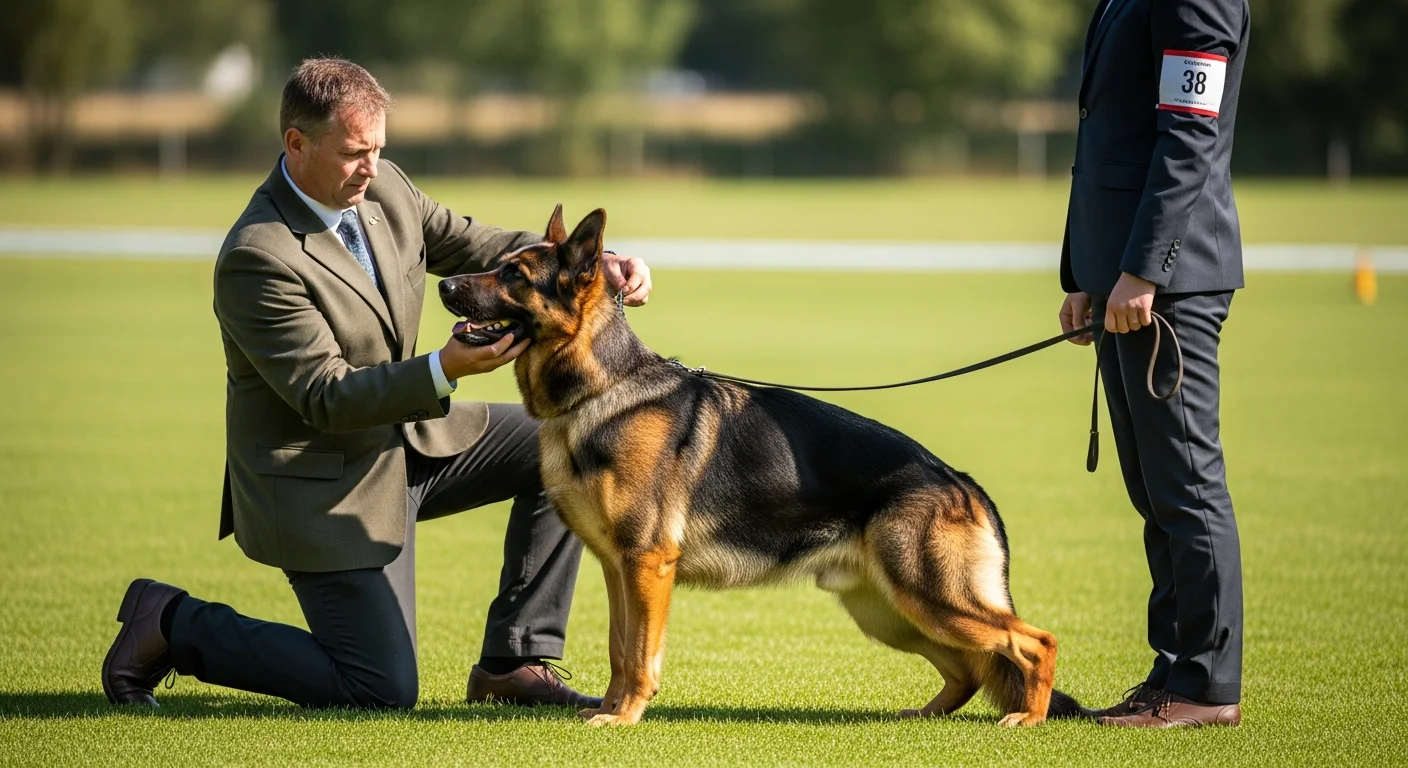
A Körung event is conducted by a licensed Körmeister — a judge certified by the breed club specifically for breed survey evaluations. The Körmeister typically has extensive experience both in conformation judging and in working dog training and evaluation. This dual expertise is the prerequisite for the role: a judge who can evaluate structure but not working behavior cannot conduct a Körung, and vice versa.
The conformation component of a Körung covers the dog systematically: head and expression, dentition and bite, neck and shoulders, topline and croup, chest and ribcage, forelimbs and hindlimbs, feet, coat, color and markings, and overall structure and balance. The examination is more detailed than what occurs at a typical conformation show. The Körmeister writes a full description of the dog's structure, noting both strengths and deficiencies, and assigns ratings to specific characteristics.
Measurements are taken and recorded: height at withers, length of body, weight. These measurements verify that the dog falls within the standard's size parameters. A dog that measures outside the permitted range fails the Körung on dimensional grounds, regardless of its other qualities.
The working component evaluates courage and nerve stability. The dog is brought into a scenario where it faces a threatening helper and must demonstrate that it can hold its ground, engage the pressure with confidence, and accept recall from its handler once the scenario resolves. This is not a full protection work evaluation — it is a character test designed to confirm that the dog's genetic foundation includes the nerve strength and drive that the breed standard requires. Dogs that are gun-shy, that flee from pressure, or that show uncontrolled aggression without handler-responsive control fail.
The German Shepherd Körung: The SV System
The SV (Schäferhund-Verein, or German Shepherd Dog Club of Germany) Körung is the most well-known breed survey system and serves as the model that other German breed clubs have adapted for their specific breeds. SV requirements for the Körung include: a minimum IGP1 title, a conformation rating of at least "Good" from an SV-licensed judge, passing scores on hip and elbow evaluations, DNA registration, and a completed Körung evaluation by a licensed Körmeister.
The SV Körung produces a comprehensive report for each dog that is published in the SV studbook and accessible to breeders internationally. The report includes the Körmeister's written assessment of the dog's structure, the numerical ratings assigned to specific characteristics, the results of the working evaluation, and the Körmeister's overall recommendation. Körung reports function as a detailed independent assessment of breeding stock quality that is available to anyone considering using a dog in their breeding program.
This transparency is not incidental. The SV studbook's accessibility is part of how the system maintains standards: breeders can examine the Körung reports of potential sires, compare them to their bitches' reports, and make informed breeding decisions based on documented quality rather than marketing materials and reputation. The written record is the accountability mechanism.
Rottweiler and ADRK Breed Surveys
The ADRK operates a breed survey system (ZTP, or Zuchteignungsprüfung) that follows the same structural principles as the SV Körung while adapting specific requirements to the Rottweiler's standard and working role. As detailed in the analysis of ADRK working title requirements, the Rottweiler breed survey evaluates both conformation and working temperament in an integrated evaluation that must be completed before breeding approval is granted.
The ADRK ZTP has historically been considered slightly less demanding in its working evaluation than the SV Körung — the courage test component, while present, does not require as advanced a degree of protection work preparation as the SV system. The conformation and health requirements are comparably rigorous. The integration of both components in a single pass/fail evaluation that must precede breeding is the shared feature that distinguishes German club systems from less demanding international alternatives.
The Körung's Information Function
Beyond its gate-keeping function — approving or rejecting breeding candidates — the Körung's most underappreciated value is its information production. A comprehensive breed survey generates a detailed written record of a dog's characteristics that is more informative than a show placement, more nuanced than a working title, and more permanent than a breeder's informal assessment.
Breeding programs that use Körung reports as primary selection tools can identify complementary pairs: a bitch with excellent working evaluation but slightly long back can be bred to a Körung-approved sire noted for correct length and strong working performance. The detailed reports make these nuanced breeding decisions possible in a way that binary pass/fail registrations cannot support. The report is not just a green light; it is a map of the dog's qualities and limitations.
This information function explains why the Körung system produces better outcomes than simpler evaluation systems even when both systems require the same minimum performance standards. More information, used intelligently, produces better breeding decisions. German clubs have understood this for over a century. The information architecture of the Körung system is one reason German working lines consistently outperform comparable lines from countries with less rigorous documentation requirements.
"I can read a Körung report and know more about a dog I have never met than about a dog I watched in the ring for twenty minutes. The report tells me what the judge measured, what they observed, what they thought about the working evaluation. It is an expert's complete assessment. A show placement tells me one judge preferred this dog over those dogs on that day. They are different kinds of information."
Breed Surveys in Other European Systems
German breed clubs are not the only European clubs maintaining comprehensive breed survey systems, though the German approach is the most formally developed and internationally recognized. Belgian breed clubs maintain breed surveys for Belgian Shepherd varieties that include working evaluations. Scandinavian clubs use mental description (MH) tests that, while structured differently from the Körung's courage test, fulfill a comparable function of providing standardized behavioral documentation for breeding candidates.
The Dutch system for Belgian Malinois and Dutch Shepherds within the KNPV working framework functions as a de facto breed survey system in that it requires demonstrated working performance before dogs are considered desirable breeding candidates within the working community. The KNPV system is less formally institutionalized as a breeding control mechanism than the SV Körung, but it achieves comparable results through market pressure: KNPV-titled dogs attract breeding interest; untitled dogs do not.
Swiss breed clubs for working breeds generally maintain breed surveys following the German model, adapted to their specific breeds. The Zuchtwart systems in European clubs complement breed surveys by providing ongoing monitoring and mentorship that formal evaluations alone cannot supply. The Zuchtwart visits litters, provides guidance to newer breeders, and maintains institutional continuity that persists across the inevitable turnover of individual club leadership.
Why the Körung Is Not Universal
If the Körung system produces better breeding outcomes than simpler evaluation systems, the question arises: why have not more breed clubs adopted it? The answer combines political, economic, and cultural factors.
The Körung requires licensed Körmeister — judges trained to conduct comprehensive evaluations rather than simply standard conformation judging or working titles evaluation. Training and licensing Körmeister requires investment in infrastructure, examination processes, and ongoing certification. Small or poorly organized breed clubs lack the institutional capacity to maintain this infrastructure.
The Körung's comprehensive requirements are also politically uncomfortable in breeds where significant portions of the breeding population would not pass. A breed club that introduces comprehensive breed survey requirements is effectively telling many of its members that their dogs are not good enough to breed. This creates political opposition that can block reform, as analyzed in the discussion of why AKC standard reform is so difficult. The clubs that maintain Körung systems have generally maintained them because they were established before large show breeding populations with insufficient working capacity developed — not because clubs found it easy to introduce them later.
The Future of Breed Surveys
The Körung faces the same pressures as other working evaluation systems: declining participation in working sports, aging training infrastructure, and the economic advantages of less demanding alternatives. German working sport participation has trended downward in several disciplines over the past decade, reducing the pool of dogs that have completed the IGP prerequisite for Körung evaluation.
Digital documentation and communication tools offer some potential for making Körung information more accessible and useful in international breeding decisions. If a Japanese breeder considering a German sire can access a detailed, current Körung report in a format they can use, the system's information function extends beyond the German-speaking market. The SV and ADRK have made progress in this direction, though full international accessibility of Körung data remains incomplete.
The Körung system's survival depends on the working communities that use and value it maintaining their engagement with working sport participation. When the prerequisite evaluations become inaccessible, the Körung itself becomes inaccessible, and with it the most sophisticated mechanism the working dog world has developed for ensuring that breeding animals meet the standards their breeds require. Maintaining the infrastructure that makes Körung participation possible is not a peripheral concern for working dog breed clubs. It is the central task of breed preservation.