
Giant Schnauzer Breed Standard Evolution: From Farm to Show Ring
The Giant Schnauzer began as a Bavarian cattle dog, used on farms in the Württemberg and Bavaria regions of southern Germany to drive livestock to market. Farmers bred for what worked: a dog large enough to move cattle, tough enough to work in cold mountain conditions, confident enough to hold ground when challenged, and biddable enough to be managed by a handler at work all day. The breed's utility was its standard. There was no document. There was just the dog the work required.
That unwritten functional standard produced an animal sufficiently impressive that it attracted the attention of dog show enthusiasts in the early twentieth century. The show ring gave the Giant Schnauzer visibility, registered status, and international distribution. It also began the process of separating selection for appearance from selection for function — a separation that has continued to the present and whose consequences are visible in the behavioral profile of many modern Giant Schnauzers compared to the dogs that early Bavarian farmers relied upon.
The Original Working Standard
Before the Giant Schnauzer was formalized as a show breed, it was selected for a specific behavioral and physical package. The physical requirements were dictated by function: the dog needed sufficient size to physically manage cattle, a harsh protective coat for weather resistance, strong jaws for grip work, and the structural soundness to work full days over rough terrain. These physical traits were not aesthetically derived. They were the physical consequences of functional requirements.
The behavioral requirements were equally specific. Cattle dogs needed enough dominance and confidence to challenge and redirect adult cattle, which are large, powerful, and not easily intimidated. They needed the trainability to respond to a working shepherd's commands in the middle of a drive. They needed nerve strong enough to maintain function in the face of a charging bull without the excessive aggression that would make them unmanageable around livestock they were not supposed to bite.
This combination — physical toughness, drive, confidence, trainability, handler focus — describes the working Schnauzer as it functioned historically. It also describes the behavioral profile that makes Giant Schnauzers effective in police and military work today, when they come from lines that have maintained this profile. The challenge is that maintaining this profile requires selection pressure that show breeding alone does not provide.
The FCI Standard and Its Limitations
The current FCI standard for the Giant Schnauzer (FCI Standard No. 181) describes a dog that is "loyal, intelligent, and reliable, with good nature and an extremely alert disposition." The standard describes structural characteristics in considerable detail: square build, strong back, well-developed muscle, correct angulation. What the standard does not describe, in operational terms, is how to verify whether any of these behavioral characteristics are actually present in a given dog.
The written description of Giant Schnauzer temperament is aspirational rather than operational. Every breed standard describes the same behavioral virtues using different adjectives. "Alert," "reliable," "good-natured" and "loyal" are not measurements. They are intentions. The gap between the written description and a verified measurement is the gap that working title requirements fill — or that disappears entirely when working requirements are absent.
The relationship between written standards and verified performance is central to understanding why the FCI versus AKC debate matters for breeds like the Giant Schnauzer. Where FCI member clubs require working evaluations, the written standard's behavioral descriptions are backed by something measurable. Where they do not, they remain aspirational.
Working Requirements for Giant Schnauzers in Germany
The PSK (Pinscher-Schnauzer-Klub), the original German breed club for Schnauzer breeds, maintained working title requirements for Giant Schnauzer breeding within Germany for much of the twentieth century. Dogs registered under PSK rules needed IGP titles to enter the breeding population, ensuring that working capacity was evaluated before breeding. This requirement placed Giant Schnauzer breeding in the same framework as German Shepherd and Rottweiler breeding under the SV and ADRK systems respectively.
The result was a German working-line Giant Schnauzer population that maintained the drives and temperament profile of the breed's historical function. These dogs were used in police service in Germany and other European countries, demonstrating practical working capacity that justified the working title requirement as something other than a bureaucratic exercise. German working Giant Schnauzers competed in IPO events and performed creditably against other working breeds.
Outside Germany, requirements varied. In countries where working titles were not required for Giant Schnauzer breeding, the working population diverged from conformation breeding populations in the familiar pattern. Show Giant Schnauzers in some countries have drifted toward the elegant end of the standard's size range, with movement that emphasizes reach and drive over functional efficiency, and temperament profiles that the working community regards as insufficient for the breed's historical role.
The Grooming Question and Standard Integrity
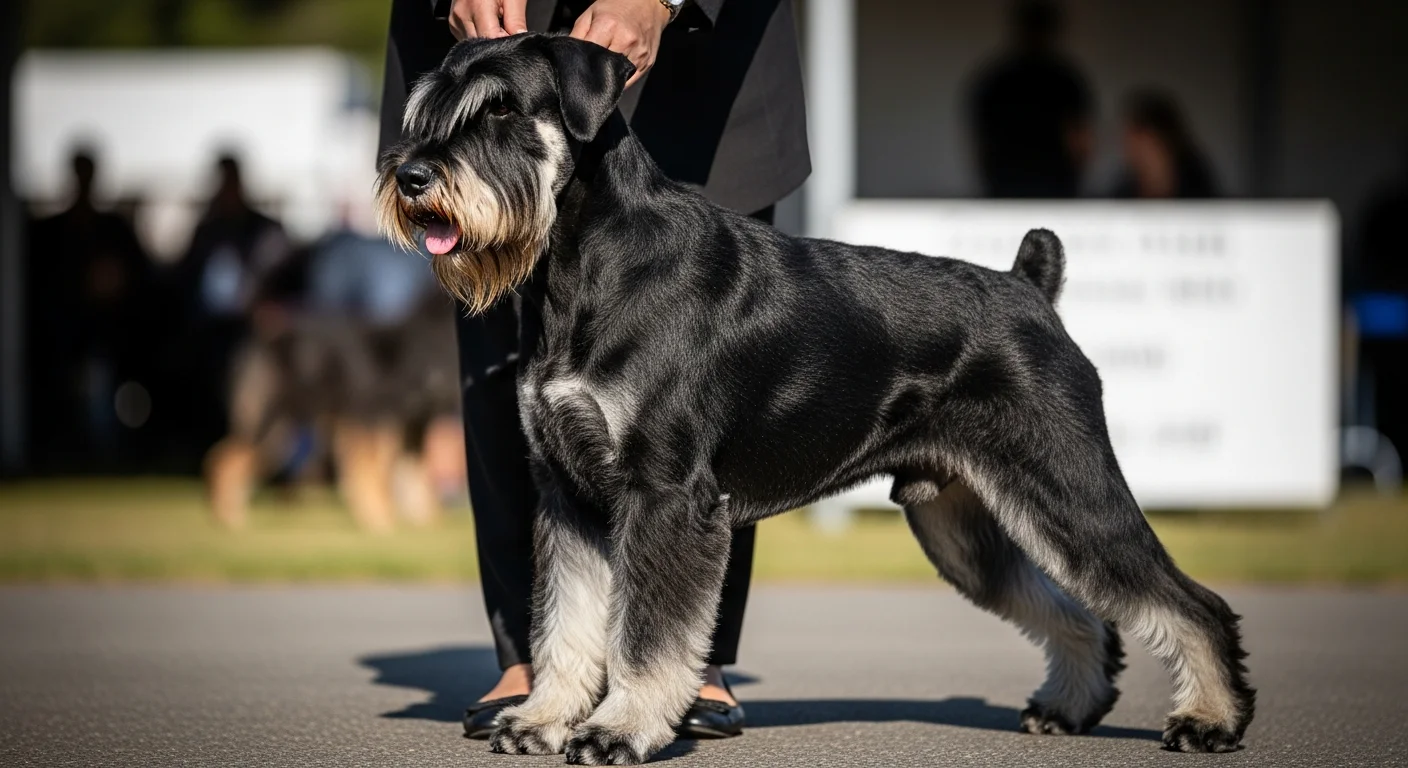
The Giant Schnauzer's appearance in the show ring involves extensive grooming — hand-stripping of the hard outer coat, sculpting of the leg furnishings and beard, presentation that emphasizes the breed's square outline. This grooming tradition has become deeply embedded in show community expectations to the point where the show-presented Giant Schnauzer bears a somewhat different visual relationship to its ungroomed self than the written standard implies.
This is not unique to the Giant Schnauzer, but it illustrates a broader problem with standards that describe physical characteristics without reference to their functional origins. The Giant Schnauzer's harsh double coat exists because it protected a working farm dog from weather and abrasion. When that coat becomes a canvas for artistic expression in the show ring, the standard has become partly aesthetic rather than purely functional. The coat is correct when it performs its protective function; the sculpted presentation at a dog show tests something different.
"A Giant Schnauzer should look like it came off a farm and could go back on one. When I see them at some international shows, they look like they have never been outside in rain. That is not what the standard described when farmers were writing it by selecting the dogs they kept."
The Police Dog Legacy
Giant Schnauzers have served as police and military dogs in Germany and elsewhere, and the working community maintains this tradition with varying intensity. German police Giant Schnauzers were notable in the mid-twentieth century, when the breed was actively competing with German Shepherds for police deployment. The Giants' intelligence, trainability, and drive made them effective police dogs when sourced from working lines.
The police deployment record of Giant Schnauzers, while less prominent than German Shepherds or Belgian Malinois, demonstrates that the breed retains working capacity when that capacity is actively selected for. Police programs that have successfully used Giant Schnauzers report characteristics consistent with the breed's historical function: high intelligence, problem-solving ability, physical durability, and a confident temperament that maintains function under pressure. These characteristics are not present in all Giant Schnauzer lines, which is precisely the point.
The breeds that have successfully maintained police and military utility — Belgian Malinois, working-line German Shepherds, Dutch Shepherds — have done so through consistent selection pressure within working-oriented breeding communities. Where Giant Schnauzer breeding has maintained that pressure, working capacity has been preserved. Where it has not, the breed's original functional profile has eroded in favor of the aesthetic profile that show breeding rewards.
Current State of the Breed
The Giant Schnauzer currently exists in a state typical of working breeds that have experienced significant show breeding pressure without universal working title requirements. A working-oriented community maintains dogs with genuine working capacity, sourcing from lines with documented IGP performance and breeding with working evaluation as a primary criterion. A show-oriented community breeds for the aesthetic qualities that succeed in conformation competition, with working capacity as a secondary or irrelevant consideration.
The two communities overlap imperfectly. Show champions occasionally demonstrate meaningful working ability; working-line dogs sometimes carry show titles. But the populations are drifting apart in the characteristic manner of split working and show populations — the structural differences in working soundness accumulate across generations when selection pressures diverge.
The Giant Schnauzer's trajectory is a representative case study, not an exceptional one. It shares the essential dynamic with Dobermans, Rottweilers, Boxers, and every other breed in which show breeding has operated independently of working evaluation for multiple generations. The breed name persists. The original dog, in its full historical form, becomes progressively rarer in populations without mandatory working requirements.